
Last updated September 22, 2026
Free on-site gate assessment - hinges, posts, and your LiftMaster or Nice gate operator checked before anything is quoted
The assessment is free and the quote is the invoice.
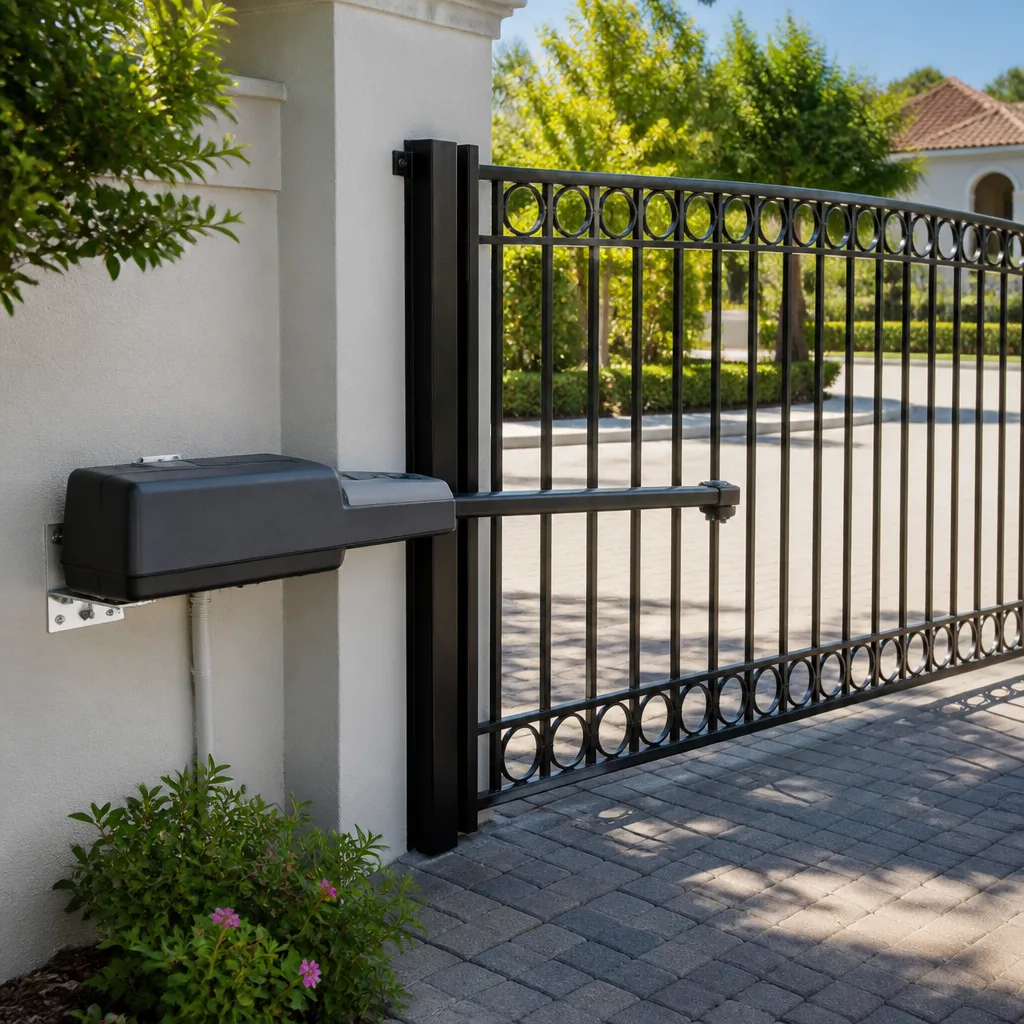
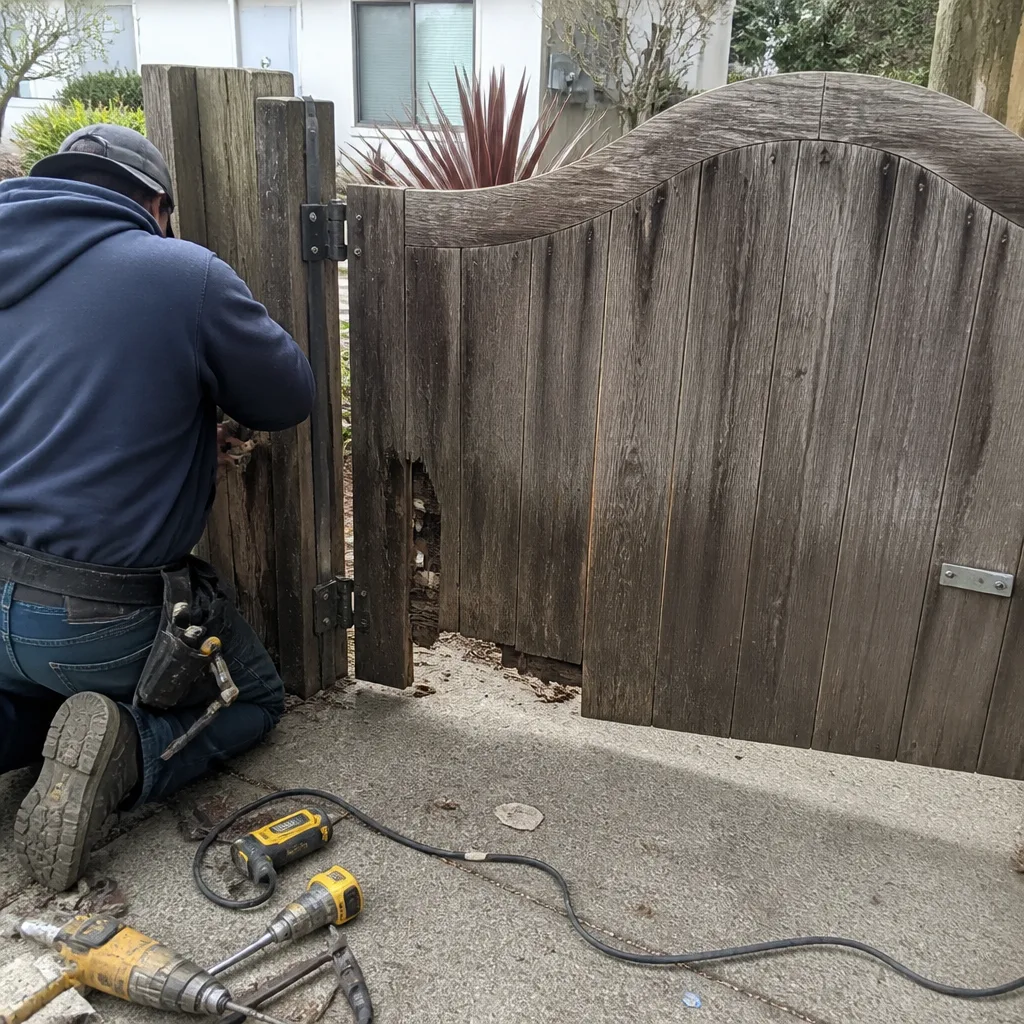 Before
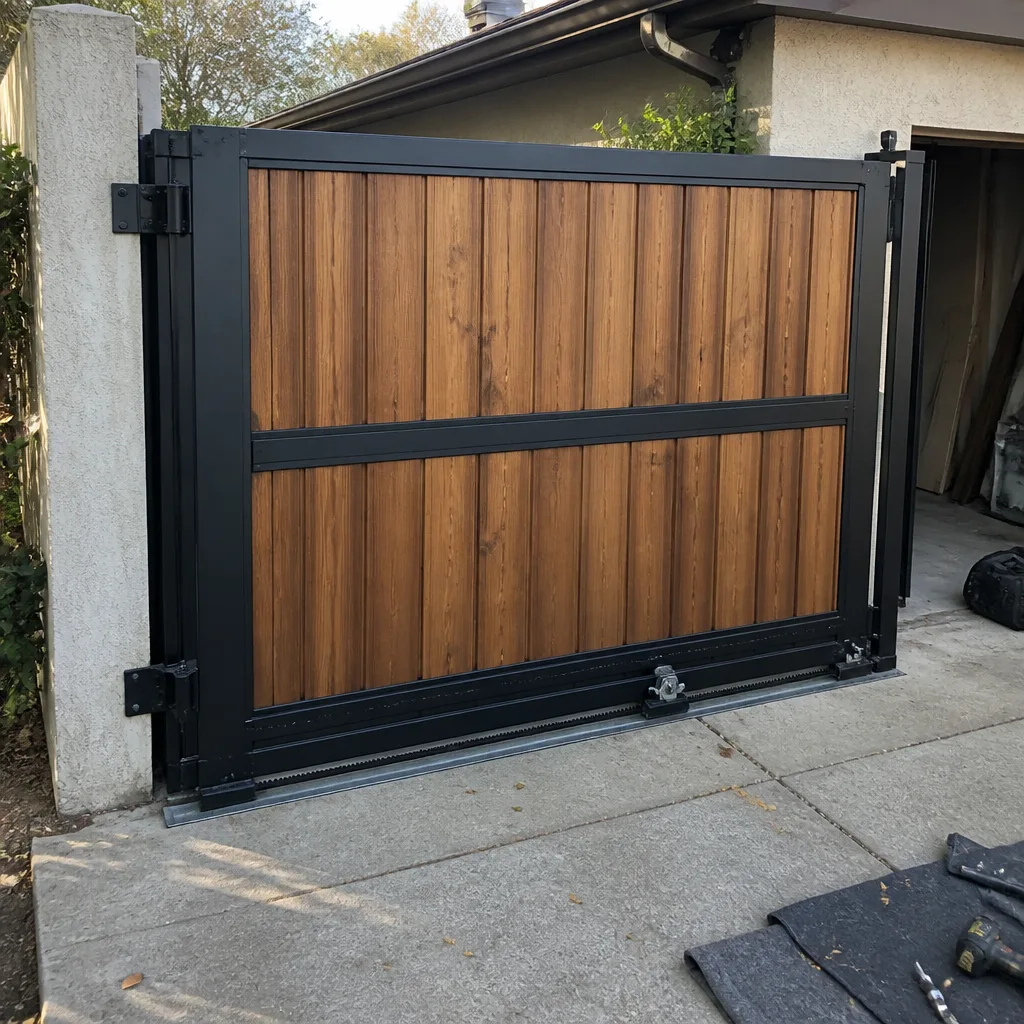 After
After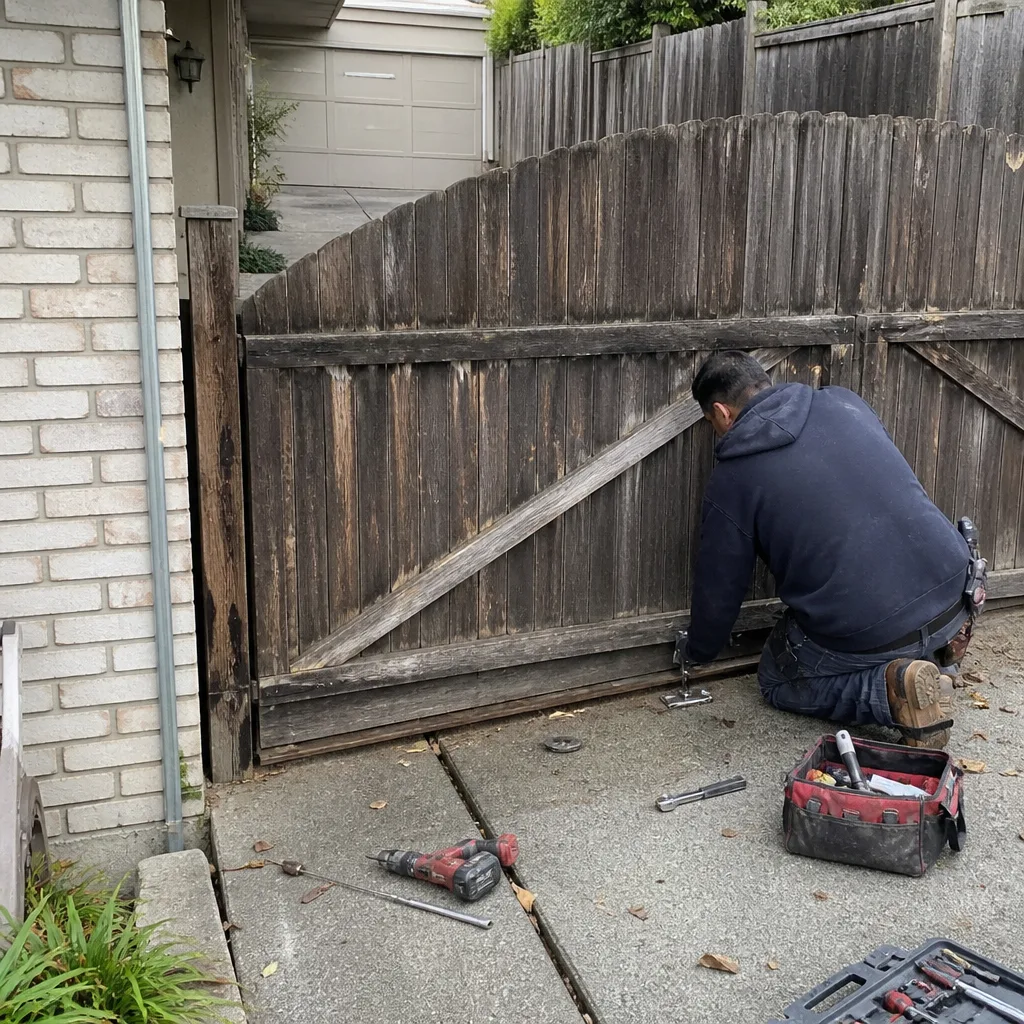 Before
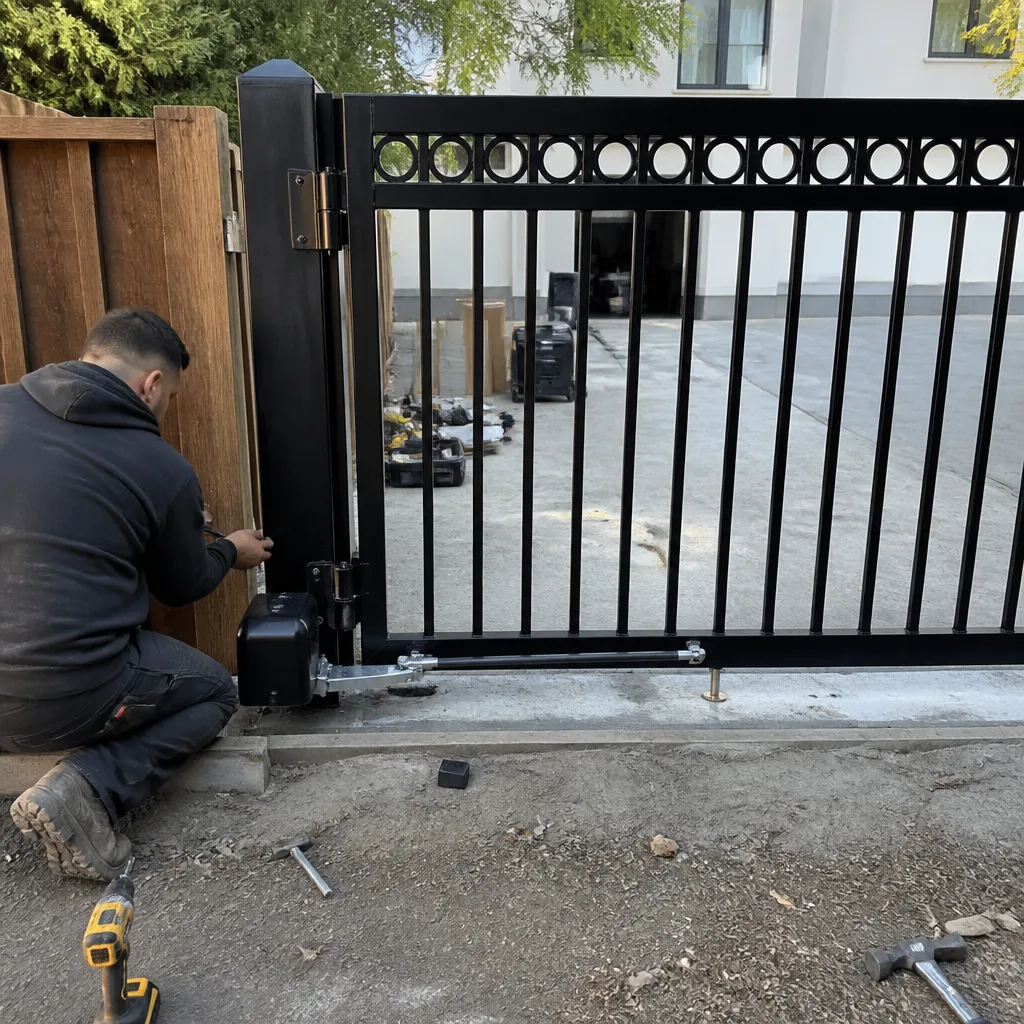 After
After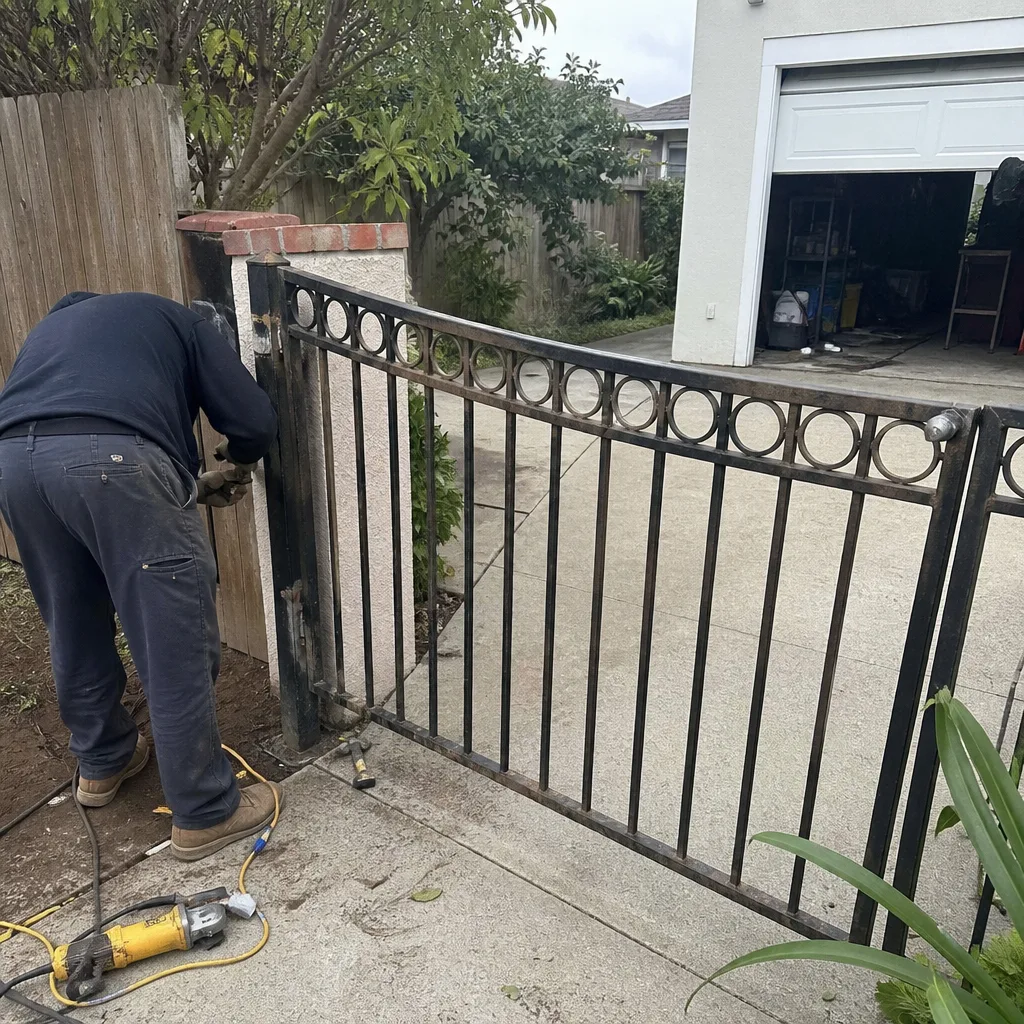 Before
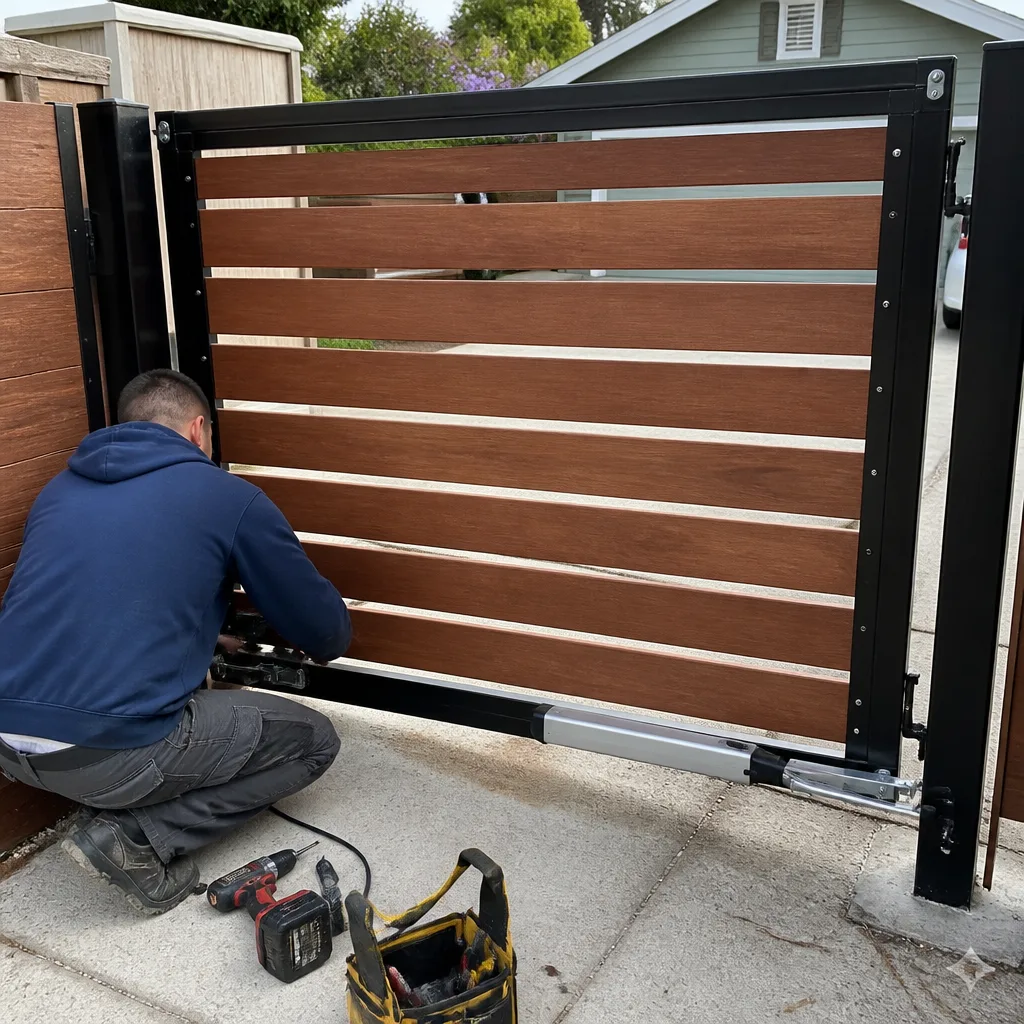 After
AfterThe Complete Guide to Gate Repair in Richmond
Most Richmond gate failures aren’t caused by the part that stopped working - they’re caused by a second, older problem that a previous technician documented verbally and never wrote down. In 22,000+ gate repairs since 2014, we’ve found that roughly 40% of “motor failures” in this city trace back to misalignment or corrosion that was noted in passing but left untreated. Richmond’s position on the Bay creates a specific failure fingerprint: salt-air corrosion attacks hardware faster than inland East Bay cities, clay-soil heave on hillside properties shifts gate posts independently of the motor, and BART-adjacent vibration loosens limit switches that inland technicians rarely encounter. This guide catalogs what actually breaks in Richmond gates, in what order, and what a proper repair record should contain so the problem stays fixed.
Quick Answer
Our Gate Repair services in Richmond typically cost $180-$650 for mechanical fixes and $340-$1,200 for motor or automation work, with most residential swing-gate repairs completed in one visit. The most common repairs in Richmond involve corrosion-damaged hinges on Bay-facing properties, clay-soil misalignment in the Richmond Hills and East Richmond Heights areas, and limit-switch drift on gates within a quarter-mile of BART tracks. A properly documented repair should leave you with a written price (agreed before work started), a photo log of findings and adjustments, and a wiring diagram or limit-switch position record for any automation work.
Table of Contents
- Why Richmond Gates Fail Differently Than Inland East Bay Gates
- Common Richmond Gate Types by Neighborhood and Their Failure Patterns
- What Gate Repair Costs in Richmond (With Real Price Ranges)
- The Three Richmond-Specific Damage Sources: Corrosion, Clay Soil, and Vibration
- What a Proper Repair Record Should Contain (And How to Spot a Patch Job)
- What You Can Check Yourself vs. What Requires a Technician
- How to Choose a Gate Repair Company in Richmond
- A Realistic Maintenance Schedule for Richmond Gate Owners
 Before
 After
AfterWhy Richmond Gates Fail Differently Than Inland East Bay Gates
Gate repair in Richmond is not the same as gate repair in Walnut Creek or Concord. The failure patterns we see here are distinct enough that a technician trained inland will often misdiagnose the root cause.
Salt-air corrosion accelerates faster than most owners expect. Richmond’s position on San Francisco Bay means prevailing westerlies carry marine aerosol inland for roughly two miles. Gates within that zone - particularly in Marina Bay, Point Richmond, and the waterfront stretches of Cutting Boulevard - show hinge pin corrosion, chain-link fence galvanic decay, and aluminum gate-frame pitting at rates we don’t see past the I-80 corridor. A hinge that might last 12 years in Pleasant Hill shows visible play in 6-8 years here. The corrosion isn’t always visible from the driveway side; we regularly find the backside of hinge plates rusted through while the front still looks presentable.
Clay-soil heave operates on a seasonal cycle that inland sandy soils don’t replicate. Richmond’s hillsides, particularly in East Richmond Heights, El Sobrante Hills, and the upper terraces of the Richmond Hills, sit on expansive clay that swells with winter rains and contracts through the dry season. A gate post set without proper drainage or a sufficient concrete footing will shift 1/4 to 1/2 inch annually. That movement doesn’t break the motor immediately. Instead, it gradually increases the load on the actuator arm or chain drive until the motor’s internal clutch slips or the circuit board throws an overload fault. The motor isn’t broken. The post is crooked. But a technician who doesn’t measure post plumb against the original installation spec will sell a motor replacement that fails again in 18 months.
BART vibration is a Richmond-specific variable that few gate manufacturers account for. Properties within roughly 1,500 feet of BART tracks - notably along the Richmond Line through downtown, the Cutting Boulevard corridor, and near the Richmond station itself - experience low-frequency vibration that loosens terminal screws, drifts limit-switch settings, and fatigues solder joints on control boards. We’ve replaced control boards on 7-year-old FAAC and Linear systems in these zones that should have lasted 15 years, and in most cases the root cause was a loose earth-ground connection that vibrated intermittently for years, causing micro-arcs that eventually degraded the board.
The result: a Richmond gate repair requires a technician who looks past the failed component to the environmental stressor that caused it. That’s why our Vance Gate Repair Richmond home process includes a full gate-system survey on every call, not just a swap of the broken part.
Common Richmond Gate Types by Neighborhood and Their Failure Patterns
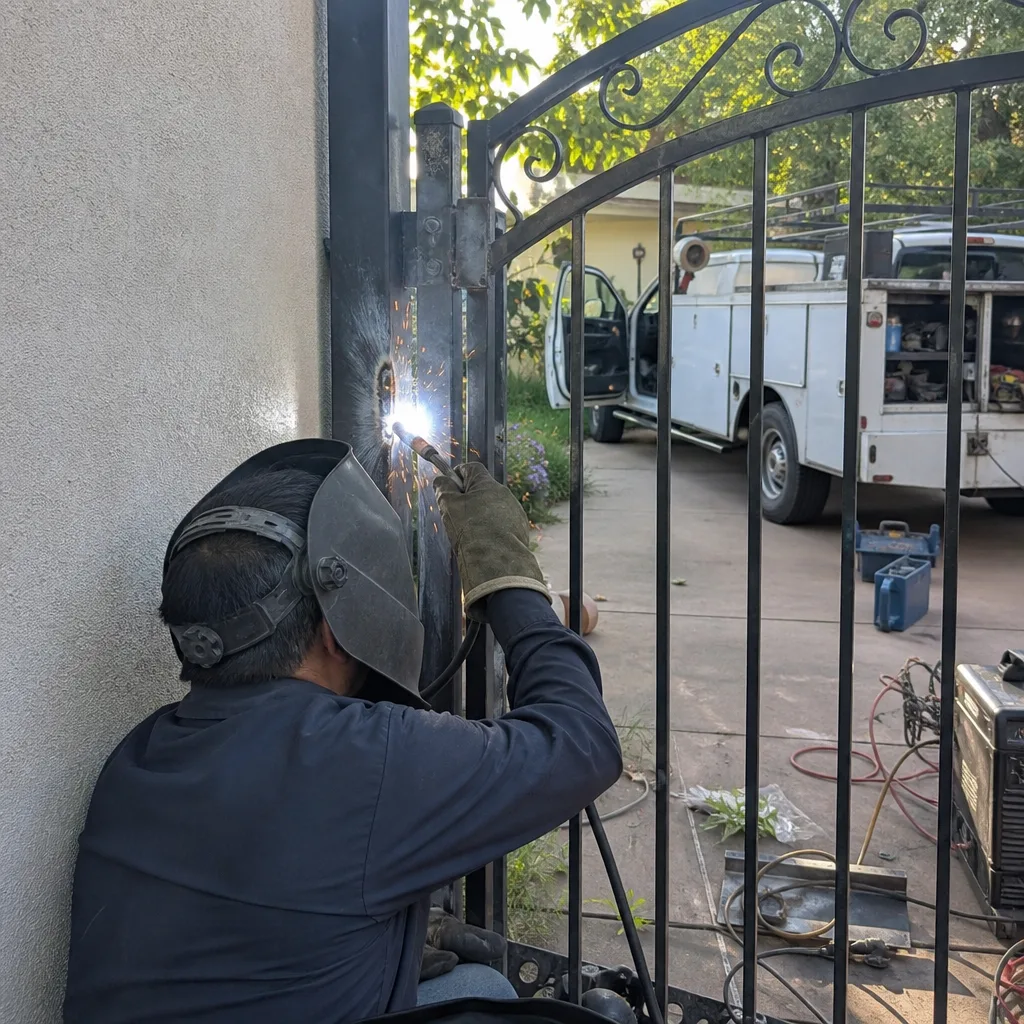
Richmond’s topography and development history created distinct gate preferences by area. Each type fails in predictable ways that a generic repair guide won’t prepare you for.
Hillside Cantilever Gates (East Richmond Heights, Richmond Hills, El Sobrante Hills)
Cantilever gates - the ones that slide on an overhead track without a ground track - dominate hillside properties where driveway slope makes a swing gate impractical. These gates carry their full weight on two or four carriage rollers running inside an aluminum or steel track.
What fails: The carriage rollers. Clay-soil movement gradually tilts the support posts, increasing side-load on the rollers. Roller bearings designed for pure vertical load start taking angular force. We see seized rollers in Richmond hillside installations at roughly twice the rate of flatland cantilever systems. The symptom is a gate that starts and stops unevenly, or a motor that strains audibly at one point in the travel.
What the repair should include: Roller replacement, post-plumb measurement, and shimming or re-pouring of the support footing if the post has shifted more than 3/8 inch from vertical. A technician who replaces rollers without checking post plumb is treating the symptom.
Flatland Swing Gates (Marina Bay, Point Richmond, Central Richmond)
Swing gates remain common on level lots where space allows. In Richmond’s flatter neighborhoods, these are typically single-panel or dual-panel systems with underground or arm-style operators.
What fails: Hinge corrosion and operator-arm bracket fatigue. The salt-air zone hits hinges first - typically the lower hinge, where splash and soil contact concentrate moisture. On underground operators (the type where the motor sits in a foundation box below grade), we see water infiltration into the foundation box after heavy rains, particularly in areas with poor yard drainage. The motor doesn’t fail electrically; the gearbox fills with muddy water and the worm gear strips.
What the repair should include: Hinge replacement with marine-grade stainless hardware, foundation-box drainage inspection, and operator-arm torque verification against the manufacturer’s spec. For underground units, the foundation box should be pumped, cleaned, and resealed - not just dried with a shop vacuum.
Commercial Slide Gates (Industrial corridors, warehouse districts, multi-family properties)
Commercial slide gates on wheel carriers are common along Richmond’s industrial waterfront and on larger multi-family properties. These carry the highest duty cycle and the most abuse.
What fails: Chain or rack drive, limit switches, and safety edges. The chain drive on a high-cycle commercial gate in Richmond accumulates abrasive grit from truck traffic and industrial particulate. Limit switches drift from vibration and repeated impact. Safety edges (the rubber bumpers with internal pressure switches) degrade from UV exposure and physical contact.
What the repair should include: Chain tension measurement and replacement if elongation exceeds 3% of pitch. Limit-switch position documentation - we photograph the switch position and record the actuator cam angle on every commercial repair. Safety-edge resistance testing; a failing edge typically shows intermittent open-circuit readings before total failure.
What Gate Repair Costs in Richmond (With Real Price Ranges)
We publish price ranges - see our Gate Repair Cost Breakdown: The Richmond Homeowner’s Reference for 2026 for detailed context - because Clause 1 of the Haven Standard requires a written price before any work starts. The ranges below reflect what we’ve actually quoted on Richmond properties in the past 24 months. Your specific price depends on gate size, brand, access conditions, and whether the problem is isolated or systemic.
| Repair Category | Typical Range | What Affects Price |
|---|---|---|
| Hinge replacement (single) | $180-$280 | Stainless vs. standard steel; post condition if welding needed |
| Hinge replacement (full set, dual-panel) | $340-$520 | Panel weight, hardware grade, alignment time |
| Roller/carriage replacement (cantilever) | $280-$450 | Roller load rating, track condition, post adjustment needed |
| Operator arm replacement (swing gate) | $420-$780 | Brand, arm length, bracket fabrication |
| Control board replacement | $380-$650 | Brand, programming complexity, auxiliary features |
| Limit switch adjustment or replacement | $140-$240 | Accessibility, switch type, documentation time |
| Safety edge replacement | $180-$340 | Length, wired vs. wireless, integration with existing loop |
| Chain or rack drive replacement (slide gate) | $320-$580 | Gate length, chain grade, sprocket condition |
| Post resetting or replacement | $480-$1,200 | Concrete removal, depth, clay-soil conditions, permit if over 6 feet |
| Full motor replacement (residential swing) | $680-$1,200 | Brand, horsepower, battery backup, solar compatibility |
| Full motor replacement (commercial slide) | $1,200-$2,400 | Duty cycle, continuous vs. intermittent, access control integration |
These are flat, all-in prices. We don’t add trip charges in Richmond, diagnostic fees, or “unexpected problem” surcharges after the fact. The price on the page before you approve it is the price on the invoice when we leave.
Free second opinion: If you have a written estimate from another company, we’ll review it at no charge. We’ve found that roughly 30% of estimates we review in Richmond recommend motor replacement when the actual problem is misalignment or a $40 limit switch.
The Three Richmond-Specific Damage Sources: Corrosion, Clay Soil, and Vibration
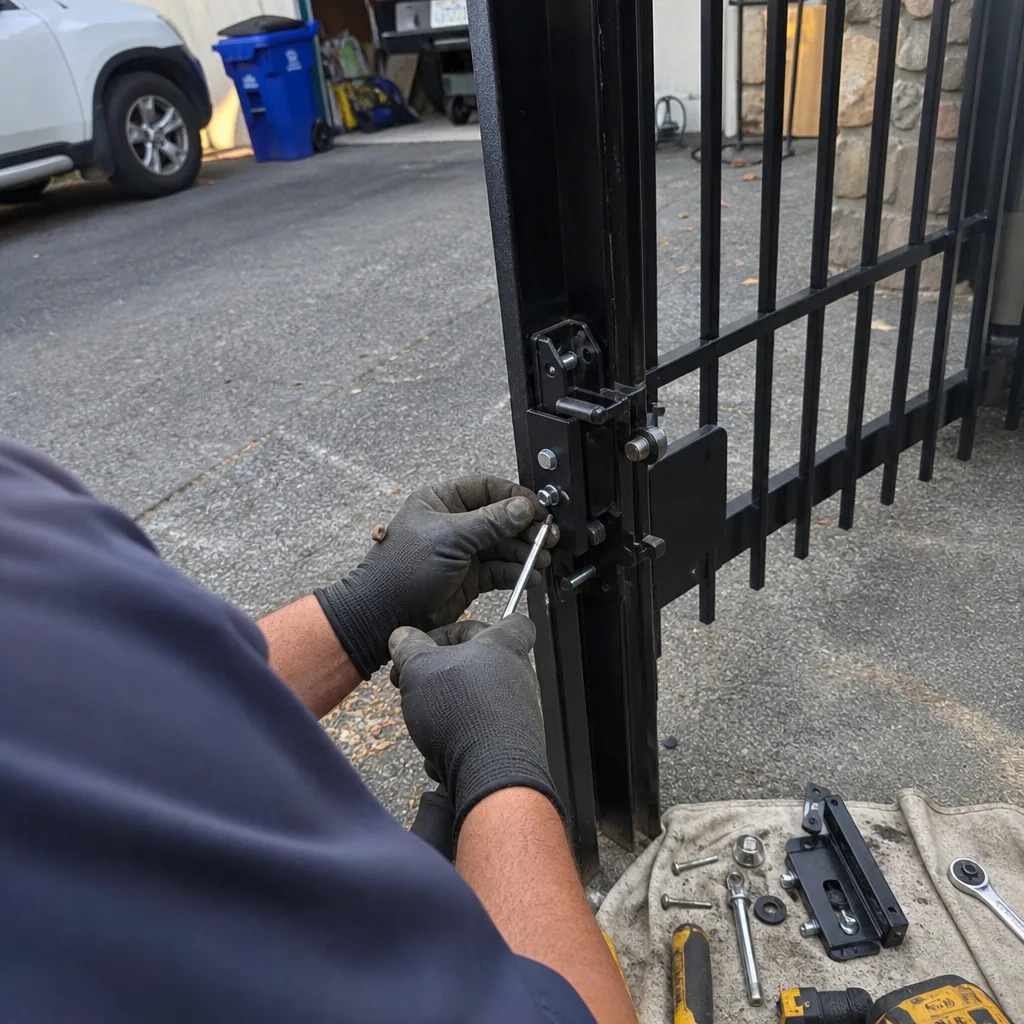
Generic gate repair content talks about “wear and tear.” In Richmond, we name the specific environmental agents and document their effects.
Bay-Adjacent Corrosion: The Hidden Timeline
Corrosion damage in Richmond follows a geographic gradient. We’ve mapped our repair records against distance from the Bay and found a clear pattern:
- Within 0.5 miles of the shoreline (Marina Bay, Point Richmond, southern Richmond Annex): Hinge pins show measurable reduction in diameter within 5-7 years. Galvanized chain-link gates develop “white rust” (zinc oxide) at welds and joints within 3 years. Aluminum gate frames pit at stress concentrations.
- 0.5 to 2 miles inland (Central Richmond, North & East, most of the Richmond Hills): Corrosion still exceeds inland East Bay norms but operates on an 8-12 year timeline for hinge degradation. The dominant issue is galvanic corrosion where dissimilar metals contact - stainless steel bolts in aluminum frames, or steel posts with aluminum gates.
- Beyond 2 miles / above 500 feet elevation (upper El Sobrante Hills, farthest Richmond Hills): Corrosion rates approach inland norms. Clay soil and vibration become the dominant failure modes.
The repair implication: a technician working in Point Richmond should default to marine-grade 316 stainless hardware, not the 304 grade that suffices inland. We specify 316 on every waterfront-adjacent repair and document the alloy in the job record so the next technician (even if it’s not us) knows what’s installed.
Clay-Soil Heave: The Misalignment That Mimics Motor Failure
Richmond’s hillside clay is expansive - it swells when wet and shrinks when dry. The seasonal cycle creates a predictable pattern of gate failure:
- October-November: First rains saturate summer-dry clay. Posts tilt slightly. Gate binds at one point in travel.
- December-February: Maximum soil expansion. Binding worsens. Motor strains. Owner calls for “motor repair.”
- March-April: Soil begins drying. Post may partially return to original position. Gate operates better. Owner defers repair.
- May-September: Dry season. Post position stabilizes, often not fully back to plumb. Motor has been overloaded for months; internal clutch or gearbox damage now appears.
The motor failure in step 4 was caused by the post movement in step 1. A technician who replaces the motor without addressing post plumb has guaranteed a repeat failure. Our standard on hillside Richmond properties: measure post plumb with a 4-foot level on every repair call, regardless of the reported symptom. Under Haven Standard Clause 4, we photograph the level reading and include it in the job documentation.
BART Vibration: The Intermittent Fault
Low-frequency vibration from BART trains propagates through soil and affects gate automation differently than road traffic. The symptoms are specific:
- Intermittent “ghost” operation - gate opens or closes without command, typically during BART operating hours
- Limit switch drift that reappears weeks after adjustment
- Control board failure with no visible surge or water damage
- Loose terminal screws that can’t be explained by thermal cycling alone
Our repair protocol for BART-adjacent properties includes vibration-resistant terminal blocks where original equipment used standard screw terminals, and thread-locking compound on all control-board fasteners. We also document the BART proximity in the job record - a detail that explains future technicians why non-standard hardware was used.
What a Proper Repair Record Should Contain (And How to Spot a Patch Job)
This is where Vance Gate Repair’s commercial documentation habit, developed by Adrian Vance starting in 2014, becomes relevant to residential customers. A proper repair record protects you from paying twice for the same diagnosis and gives any future technician the information needed to maintain the system correctly.
Every repair we complete in Richmond leaves the customer with:
- Written scope and price (Haven Standard Clause 1): What was found, what will be done, what it costs, signed before work starts.
- Photo log (Clause 4): Date-stamped photographs of the gate condition on arrival, the specific problem found, adjustments made, and the completed state. For automation work, this includes close-ups of wiring terminals, limit-switch positions, and control-board settings.
- Technical record: For motor or control work, a wiring diagram sketch or reference to the manufacturer’s diagram with any site-specific modifications noted. For mechanical work, torque specifications for fasteners and alignment measurements.
- Part identification: Manufacturer, model number, and serial number of any component installed - not just “new motor” but “LiftMaster CSW200UL, serial XXXXXX, installed [date].”
- Technician identification: Name and license number of the technician who performed the work.
How to spot a patch job: The technician can’t produce any of the above. Verbal descriptions (“I adjusted the limits”) with no position record. “New motor” with no model number. No photographs. A handwritten receipt with no scope description. These aren’t just paperwork failures - they’re indicators that the root cause wasn’t investigated. We’ve followed technicians in Richmond who “repaired” the same limit switch three times in two years because they never documented that the real problem was a loose actuator cam that drifted under vibration.
The 365-Day Done Right Promise exists because we trust our documentation. If a repair fails within a year, we pull the job record, see exactly what was done, and fix it without argument or additional charge. A company that won’t warranty work for a full year often can’t - they don’t know what their previous technician actually did.
What You Can Check Yourself vs. What Requires a Technician
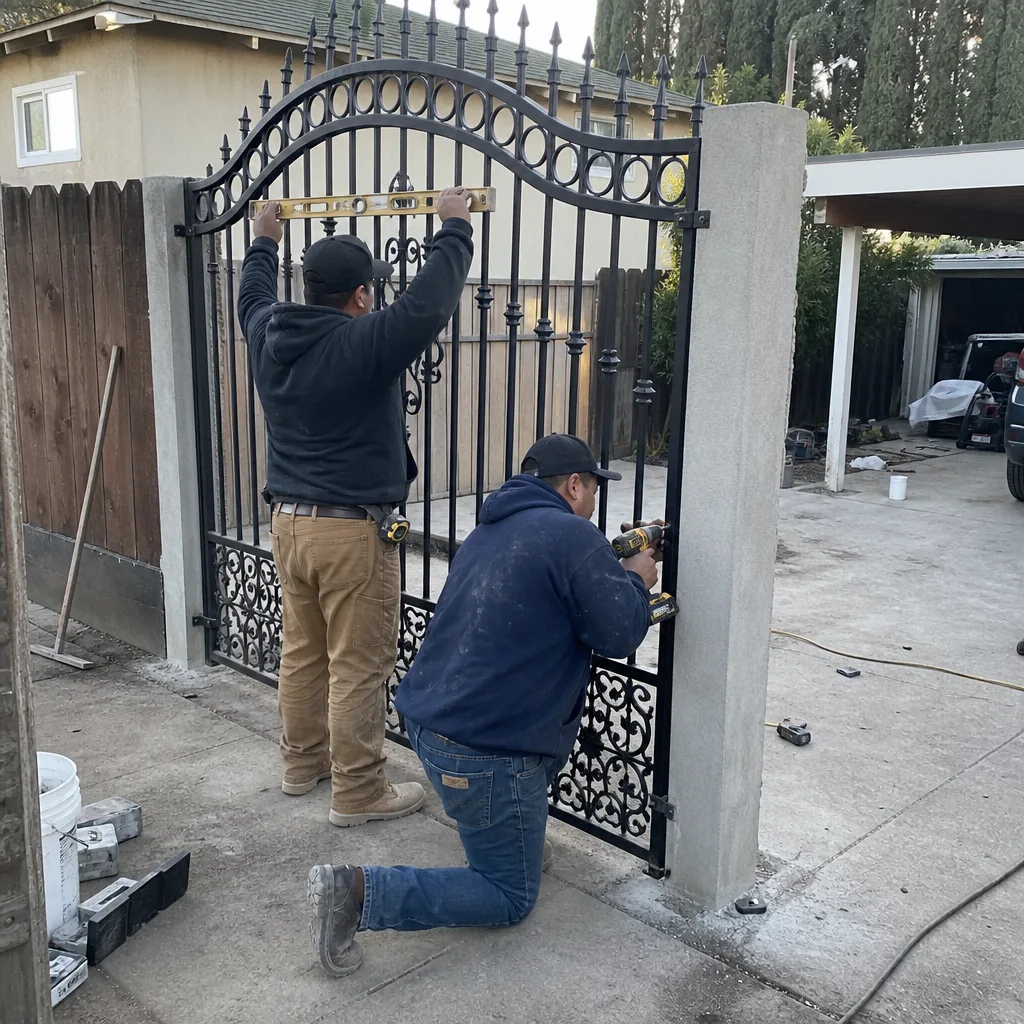
Some gate problems are safe to investigate; see our DIY vs Professional Gate Repair: The Richmond Homeowner’s Decision Guide for details. Others involve stored energy or electrical hazards that require specific training and tools.
Safe Checks for Homeowners
- Visual hinge inspection: Look for rust streaks, cracked welds, or visible gap between hinge leaf and post. If the gate sags when manually lifted, the lower hinge is worn.
- Photo-eye alignment: Most systems have LED indicators on the photo-eye housings. Both should show solid green or red when the gate is clear. Flashing or off indicates misalignment or obstruction.
- Manual release test: With the gate fully closed and power off, operate the manual release (typically a key or lever on the motor) and verify the gate moves freely by hand. Binding indicates mechanical problems, not motor problems.
- Obstruction sweep: Remove leaves, debris, or objects from the gate path and photo-eye line of sight.
What Requires a Professional
- Spring-assisted or counterweighted gates: These store significant mechanical energy. Improper release can cause uncontrolled gate movement.
- High-voltage electrical work: Control board replacement, wiring modifications, or troubleshooting beyond visual inspection of terminals.
- Post or footing work: Excavation near underground utilities, concrete work, and structural load calculations.
- Any repair where the root cause isn’t obvious: If you’ve checked the basics and the problem persists, the cause is likely systemic (misalignment, vibration damage, or control-logic issues) rather than a single failed component.
Safety note on high-tension components: Some industrial and older residential slide gates use tensioned counterbalance springs or cable systems. These components are under significant load and can cause serious injury if released improperly. Never attempt to disassemble or adjust these. A trained technician has the tools and procedures to safely de-tension and re-tension these systems.
How to Choose a Gate Repair Company in Richmond
The gate repair market in Richmond includes general handyman services, fence companies that added motors, and dedicated automation specialists. Here’s how to distinguish them.
Ask for documentation examples before you hire. A company that can’t show you a sample job record (photos, wiring notes, part numbers) won’t produce one for your repair. We show prospective customers a redacted example on request - it’s the fastest way to demonstrate the difference between our process and a verbal-estimate operation.
Verify brand coverage. Many Richmond properties have existing FAAC, BFT, or Linear systems installed by previous owners. A company that only services LiftMaster or Mighty Mule will steer you toward replacement rather than repair. We service nine major brands - gate motor and opener repair in Richmond covers whatever is already on your property.
Check for specific Richmond experience. Ask how the company handles clay-soil misalignment or salt-air corrosion. Generic answers (“we check everything”) indicate inland experience. Specific answers (“we measure post plumb with a 4-foot level and specify 316 stainless within a mile of the Bay”) indicate Richmond-specific knowledge.
Confirm the warranty terms in writing. A 30- or 90-day warranty is common in this trade and often indicates the company doesn’t trust its own diagnosis. Our 365-Day Done Right Promise covers all completed work with no expiration within that window - the full year is needed to verify that clay-soil movement or vibration hasn’t caused recurrence.
Verify live phone availability. Gate failures don’t observe business hours. A company that routes calls to voicemail after 6 PM or on weekends will leave you with a stuck gate when you most need access. We have a live person answering calls 24 hours a day, seven days a week - no automated attendant, no callback queue.
A Realistic Maintenance Schedule for Richmond Gate Owners
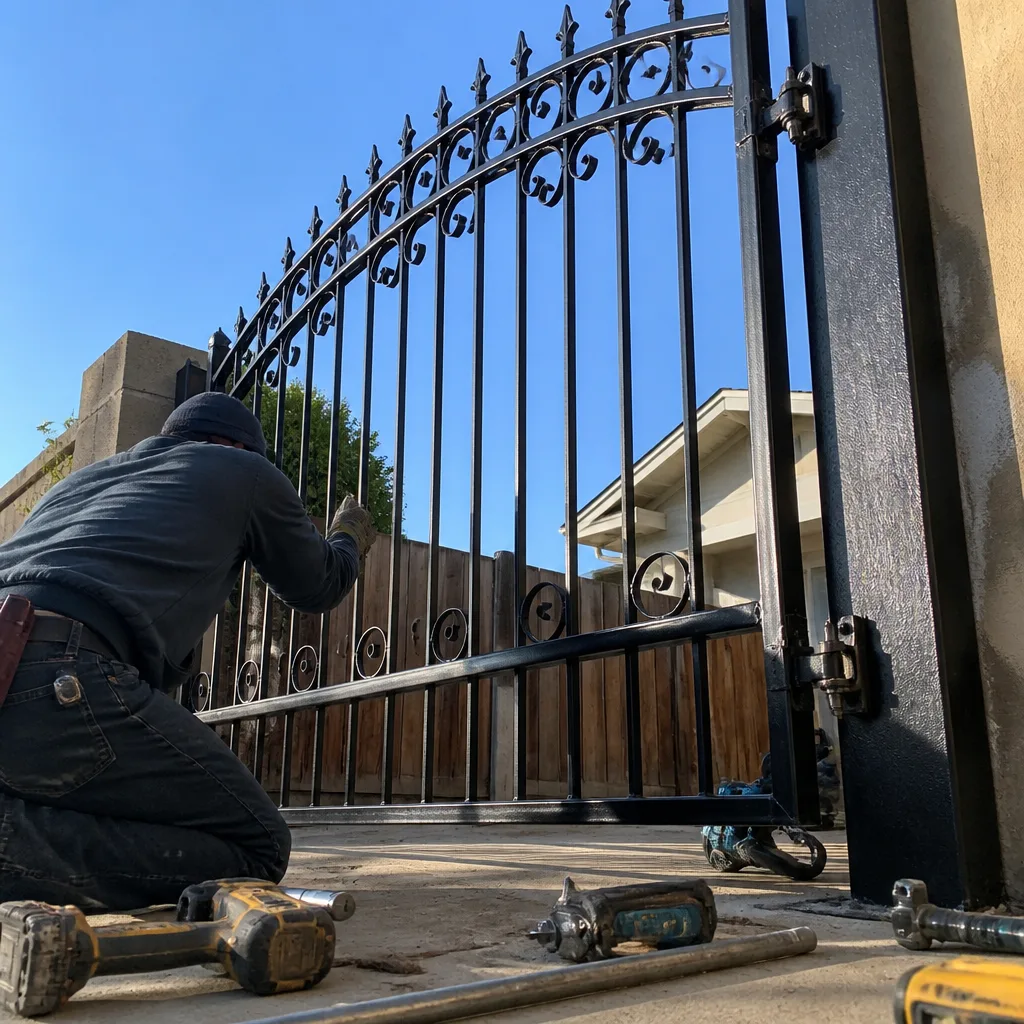
Preventive maintenance in Richmond must account for the three local stressors. This schedule is based on our repair records and manufacturer recommendations adjusted for local conditions.
Monthly (Owner-performed)
- Visual inspection of hinges, rollers, and chain for rust or debris accumulation
- Photo-eye lens cleaning with soft cloth
- Manual release operation to verify free movement
Quarterly
- Hinge lubrication with lithium-based grease (not WD-40, which evaporates)
- Chain or rack drive lubrication per manufacturer spec
- Foundation box inspection for water intrusion (underground operators)
Annually (Professional service recommended)
- Full mechanical inspection: post plumb, hinge wear measurement, roller bearing condition, chain elongation
- Electrical system test: control board diagnostic, limit-switch position verification, safety-edge function test, photo-eye alignment and response-time measurement
- Corrosion assessment: hardware grade verification, galvanic isolation check, protective coating condition
- Documentation update: wiring diagram verified against actual field conditions, job record archived
For properties within the salt-air zone or within 1,500 feet of BART tracks, we recommend professional service every 8-10 months rather than annually; find more guides & resources on our blog. The incremental cost of more frequent maintenance is typically recovered by avoiding emergency repair calls and premature component replacement.
Common Mistakes to Avoid
- Replacing the motor without checking post alignment. In Richmond’s clay-soil zones, this is the most expensive mistake we see. A $1,200 motor replacement fails in 18 months because the post continues to shift. Always verify post plumb before authorizing motor work on hillside properties.
- Using standard-grade hardware on waterfront-adjacent gates. 304 stainless or zinc-plated steel will corrode visibly within 3-4 years in Point Richmond or Marina Bay. The small premium for 316 stainless hardware pays for itself in longevity.
- Ignoring intermittent operation as “just a glitch.” In BART-adjacent properties, intermittent ghost operation or limit drift is early-stage vibration damage. Addressing it when first noticed typically costs $140-$240 for terminal tightening and switch adjustment. Waiting until total failure often requires $380-$650 control board replacement.
- Accepting a verbal estimate. Without a written scope and price, you have no recourse if the final invoice exceeds expectations. Haven Standard Clause 1 exists because we’ve seen too many Richmond homeowners pay 40% more than discussed because “we found additional problems.”
- Deferring repair through the dry season. Clay-soil misalignment often partially self-corrects in summer, tempting owners to delay. By fall, the motor has accumulated months of overload damage. The deferred $280 hinge adjustment becomes a $680 motor replacement.
- Hiring a fence company for automation problems. Fence installers understand posts and welds. Control logic, limit-switch programming, and safety-system integration require specific training. We’ve repaired many Richmond gates where a fence company’s “fix” created a safety hazard by bypassing photo-eyes or safety edges.
- Not requesting the previous repair record. If you’re in a home with an existing gate system, ask the seller for any maintenance or repair documentation. Even a basic receipt helps the next technician understand the system’s history. Absence of records should prompt a more thorough initial inspection.
When to Call a Professional
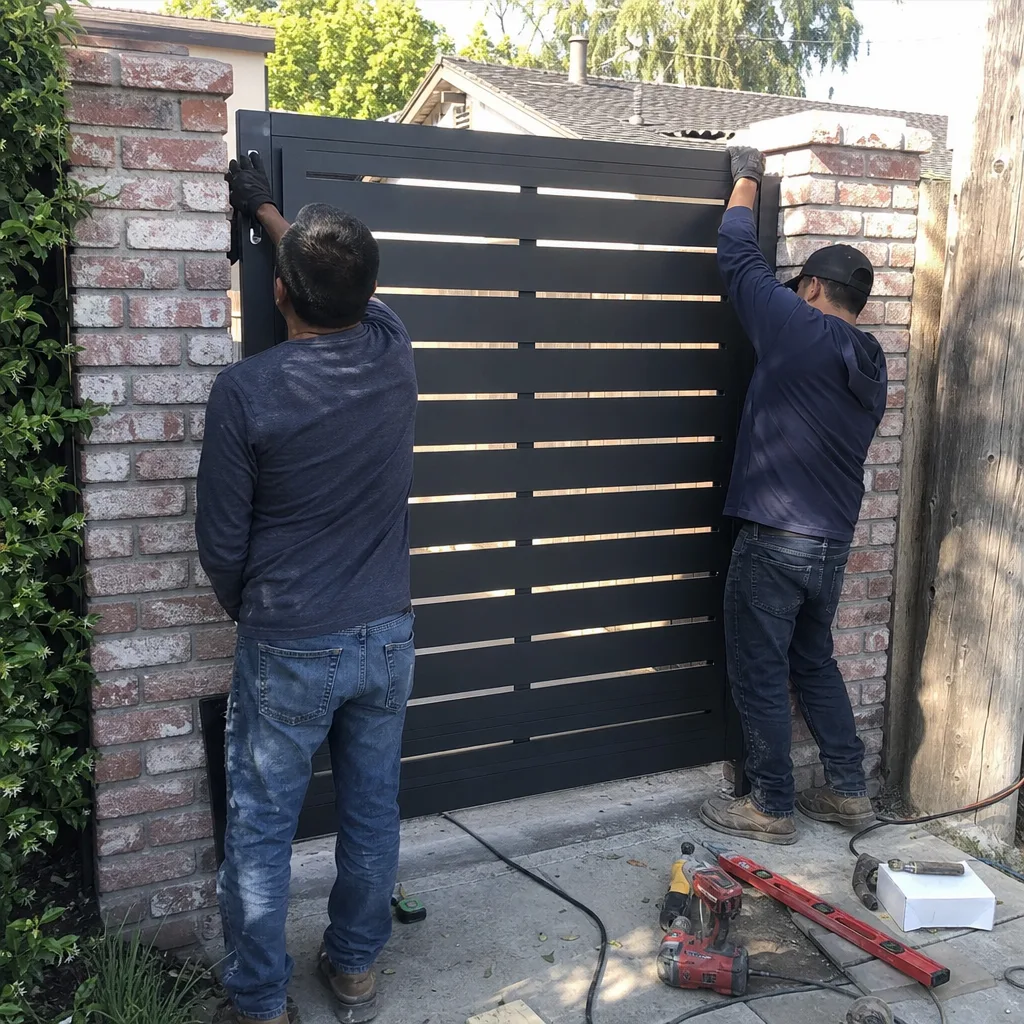
Call a technician when the gate doesn’t respond to your safe checks, when the problem recurs after initial correction, or when any high-tension or high-voltage component is involved. Specifically: persistent motor overload faults, repeated limit-switch drift, visible post movement or gate sag, water in the operator foundation box, or any safety system malfunction (photo-eye or safety edge not responding).
Vance Gate Repair Richmond offers free estimates in Richmond - call (510) 944-0953. A live person will answer, gather the basic details, and schedule a technician visit. You’ll receive a written price before any work starts, and every visit includes the documented photo record under Haven Standard Clause 4. For new gate installation in Richmond, we provide a free measure and written proposal rather than a phone estimate.
Frequently Asked Questions
Most residential gate repairs in Richmond run $180-$650 for mechanical work and $340-$1,200 for automation or motor repairs. Hinge replacement typically costs $180-$280 per hinge, while full motor replacement on a residential swing gate ranges $680-$1,200 depending on brand and features. We provide a flat, written price before any work begins - call (510) 944-0953 for a free estimate.
In our experience, roughly 60% of “motor failures” in Richmond are actually control board, limit switch, or wiring issues that don’t require full motor replacement. We service nine major brands including LiftMaster, FAAC, BFT, and Linear, and we repair existing equipment whenever possible. If replacement is genuinely needed, we’ll show you the diagnostic evidence and quote a written price before proceeding.
Clay-soil movement on Richmond hillsides causes post shifting that mimics motor failure. A technician who replaces the motor without checking post plumb has treated the symptom, not the cause. Our standard includes post-plumb measurement on every hillside call, with photographic documentation. The 365-Day Done Right Promise covers recurrence if our initial diagnosis missed a contributing factor.
A live person answers our phones 24 hours a day, seven days a week. For gates that are completely inoperable and blocking vehicle access, we prioritize same-day response in Richmond when possible. For non-emergency repairs, we typically schedule within 24-48 hours. Call (510) 944-0953 to discuss your situation.
Under the Haven Standard, every repair leaves you with: a written scope and price (agreed before work started), a date-stamped photo log of findings and adjustments, part numbers for any components installed, and the technician’s name and license number. For automation work, this also includes limit-switch positions or a wiring diagram reference. If your last repair didn’t include this documentation, you received a patch job, not a documented repair.
Most gate repairs don’t require permits. Replacement of an existing gate on the same footprint typically doesn’t either. New installations, height increases above 6 feet, or structural post work may trigger Richmond building department requirements. We identify permit needs during our initial survey and include permit handling in our written scope when applicable - never as a surprise addition.
The Bottom Line
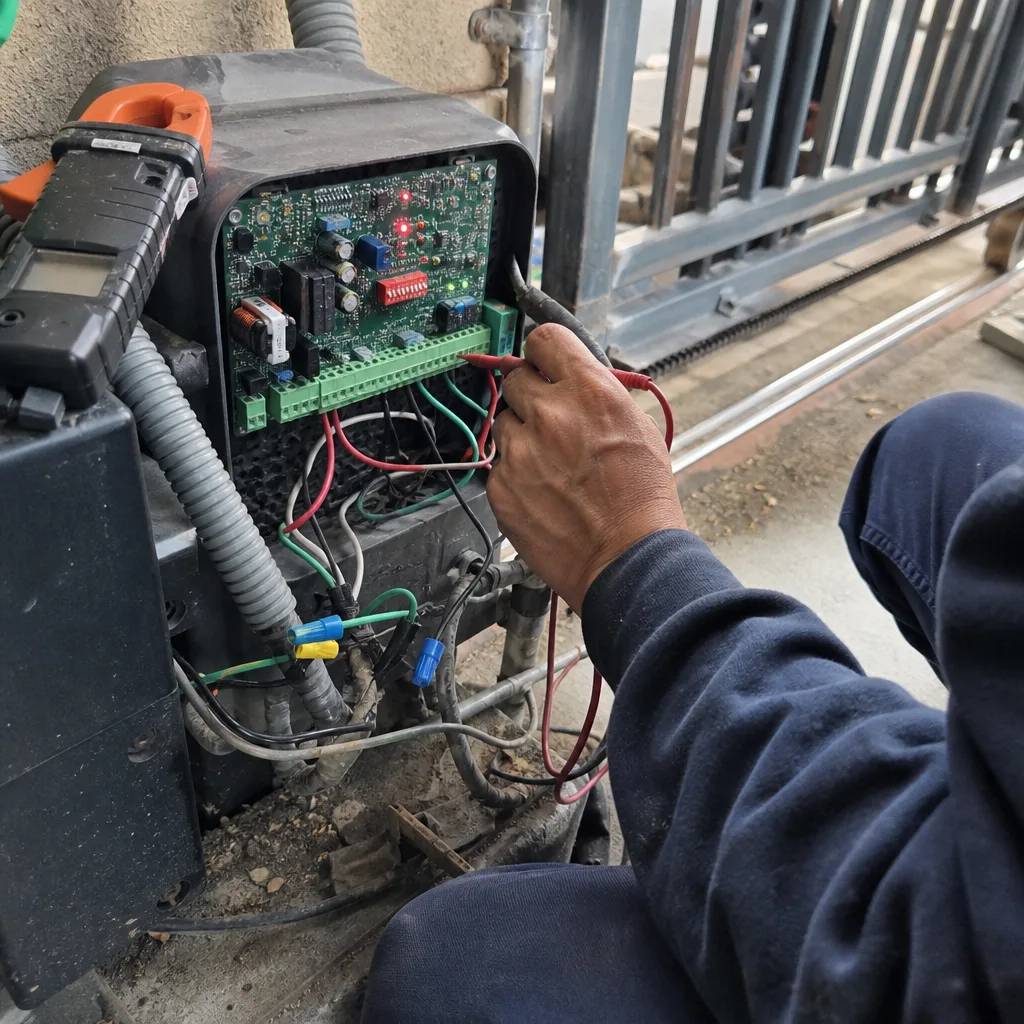
Richmond gate repair requires understanding three local stressors that inland technicians rarely encounter: salt-air corrosion accelerated by Bay proximity, clay-soil heave on hillside properties, and low-frequency vibration near BART corridors. The most expensive mistake is replacing a motor when the root cause is environmental damage to the mechanical system. The best protection is a repair process that documents everything - written price before work, photo record after, and a full year of warranty coverage to verify the fix held. If your gate is showing symptoms or you’ve received an estimate that doesn’t feel complete, we’re happy to review it at no charge.
Call (510) 944-0953 for a free estimate. A live person will answer, and you’ll get a written price before any work starts.
Written by Adrian Vance, Owner at Vance Gate Repair Richmond, serving Richmond since 2014.